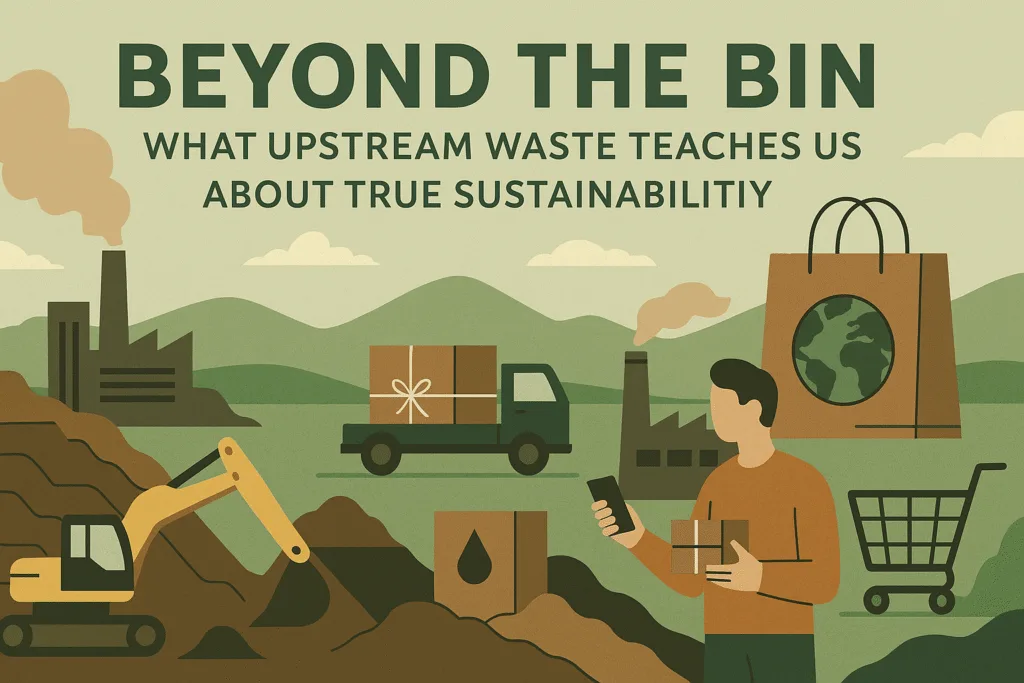
Most conversations about sustainability start at the bin—recycling, composting, and reducing what we throw away. But the real environmental cost begins long before anything reaches our hands. Every product we buy carries a hidden footprint created during extraction, manufacturing, packaging, and transport. This is upstream waste, and understanding it is one of the most powerful shifts we can make toward true sustainability.
Upstream waste is the part of the waste cycle we never see, yet it shapes everything from climate emissions to deforestation to water scarcity. When we focus only on what happens after disposal, we miss the biggest opportunity to reduce our impact.
🔍 What Is Upstream Waste?
Upstream waste includes all the environmental impacts generated before a product reaches the consumer. This includes:
- Raw material extraction (mining, drilling, logging, farming)
- Manufacturing and processing
- Packaging production
- Global transport and distribution
- Energy and water used throughout the supply chain
A single plastic bottle, for example, carries the footprint of oil extraction, refining, bottle manufacturing, and shipping—long before it ever reaches a recycling bin.
Upstream waste is invisible, but it is massive.
📊 The Global Scale of the Problem
The numbers are staggering:
- 🌍 The world generates over 2.01 billion tonnes of municipal solid waste annually, expected to grow to 3.4 billion tonnes by 2050.
- 🏭 For every 1 kg of consumer waste, up to 70 kg of upstream waste may be generated during production.
- 💻 In electronics, 80% of the environmental impact occurs before the product reaches the user.
- 🛢️ The hidden cost of global waste—including pollution, health impacts, and climate damage—was estimated at $361 billion in 2020, and could rise to $640 billion by 2050 without urgent action.
This means that even products we think of as “recyclable” or “eco-friendly” may carry a heavy upstream burden.
🌍 The Scale of the Hidden Problem
Upstream waste is responsible for the majority of a product’s environmental impact. Some key insights:
- The world generates 2.01 billion tonnes of municipal solid waste each year, projected to reach 3.4 billion tonnes by 2050.
- For every 1 kg of consumer waste, up to 70 kg of upstream waste is created during production.
- In electronics, 80% of the environmental impact occurs before the device reaches the user.
- The global cost of waste—including pollution, health impacts, and climate damage—was estimated at $361 billion in 2020, rising toward $640 billion by 2050.
This means even “eco‑friendly” products can carry a heavy upstream burden if their supply chains are resource‑intensive.
🌿 Why Upstream Waste Matters More Than We Think
Focusing only on downstream waste (what we throw away) gives us an incomplete picture. Upstream waste matters because:
- Most emissions happen before we buy the product, especially in food, fashion, and electronics.
- It’s invisible, making it harder for consumers to make informed choices.
- It drives resource depletion, deforestation, water scarcity, and pollution long before disposal.
- It reveals the true cost of consumption, not just the waste we see.
Understanding upstream waste shifts sustainability from “How do I dispose of this?” to “Should this product exist in the first place?”
🧭 How to Reduce Upstream Waste in Everyday Life
Reducing upstream waste doesn’t require perfection—it requires awareness and small, consistent shifts. Here are practical ways to start:
1. Buy Less, Buy Better
Every product avoided is upstream waste prevented. Choose items that are:
- Durable
- Repairable
- Ethically made
- Designed to last
A single high‑quality item often replaces years of low‑quality purchases.
2. Support Circular Systems
Circular economy models reduce extraction and extend product life. Look for:
- Refill stations
- Repair cafés
- Second‑hand shops
- Remanufactured electronics
- Reusable packaging systems
These options dramatically cut upstream waste.
3. Choose Low‑Impact Materials
Materials like bamboo, hemp, recycled metals, and organic cotton often have lower upstream footprints than plastics or virgin materials.
4. Ask Better Questions
Before buying, pause and ask:
- Who made this?
- What resources were used?
- How far did it travel?
- Can I repair it?
- What happens at the end of its life?
Curiosity is a powerful sustainability tool.
5. Support Transparent Brands
Brands that disclose supply chain emissions, water use, and sourcing practices are more likely to reduce upstream waste.
🌦️ Real‑Life Examples of Upstream Waste Reduction
In the Kitchen
- Choosing loose produce over packaged reduces packaging production.
- Using beeswax wraps avoids the upstream footprint of plastic wrap.
- Buying bulk pantry staples cuts transport and packaging waste.
In the Wardrobe
- Buying second‑hand reduces textile production, dyeing, and water use.
- Choosing natural fibers reduces microplastic pollution and chemical processing.
In Tech
- Repairing a phone instead of replacing it avoids the upstream mining and manufacturing footprint of a new device.
- Buying refurbished electronics cuts emissions by up to 70%.
In Daily Habits
- Carrying a reusable bottle avoids the upstream footprint of single‑use plastic.
- Choosing local products reduces transport emissions.
⚠️ Common Mistakes to Avoid
Focusing only on plastic — metals, textiles, and electronics often have higher upstream impacts.
Thinking recycling is enough — recycling addresses downstream waste, not upstream extraction.
Buying “eco‑friendly” products excessively — overconsumption is still wasteful, even if the product is green.
Ignoring supply chains — a product can be biodegradable yet still have a massive upstream footprint.
What is upstream waste in simple terms?
It’s the hidden environmental impact created before a product reaches you—during extraction, manufacturing, packaging, and transport.
Why is upstream waste worse than downstream waste?
Because most emissions, pollution, and resource use happen before disposal, not after.
How can I reduce upstream waste at home?
Buy less, choose durable products, support circular systems, and avoid unnecessary packaging.
Are eco‑friendly products always low‑waste?
Not necessarily. Some require intensive resources to produce. Always check supply chain transparency.
What industries create the most upstream waste?
Fashion, electronics, food production, and construction are among the highest.
🌍 Final Thoughts
True sustainability begins long before the bin. When we shift our focus upstream, we see the full story of our consumption—the extraction, energy, water, and labor behind every product. This awareness empowers us to make choices that reduce waste before it even exists.
Small shifts matter. Asking better questions matters. Choosing less, choosing better, and choosing circular systems matters.
Because when we look beyond the bin, we discover the real power we have to shape a sustainable future.