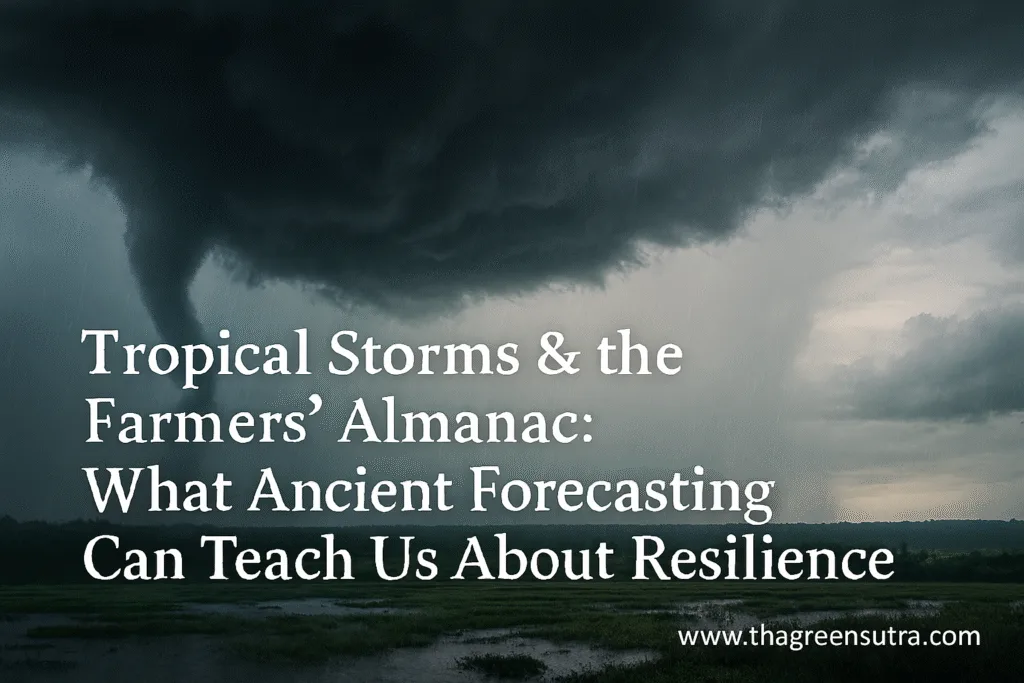
As Tropical Storm Erin stirs headlines and the Farmers’ Almanac winter forecast reaches peak search interest, many are asking:
“When will it start cooling down?”
“How accurate are these predictions?”
But beneath the urgency lies a deeper question—how can we prepare not just physically, but soulfully?
Today’s weather is unpredictable. Storms come quickly, seasons feel off, and it’s hard to know what’s next. But old forecasting methods—like the Farmers’ Almanac or indigenous seasonal calendars—don’t just give weather predictions.
They help us feel more connected to nature. Instead of just reacting to the next storm, they teach us to live in tune with the seasons and prepare calmly, with care.
📜 The Farmers’ Almanac: A Legacy of Observing Nature
First published in 1818, the Farmers’ Almanac is more than a quaint relic of agrarian life. It’s a living document that blends astronomical data, long-range weather predictions, and folk wisdom.
The Farmers’ Almanac uses a secret formula—based on sunspots, lunar cycles, and planetary positions—to make its forecasts. Modern meteorologists often dismiss these methods as pseudoscience. Yet, the Almanac’s enduring popularity speaks to something deeper: our longing for connection with nature’s patterns.
People who grow food have used the Farmers’ Almanac for many years. It helps them know the best time to plant and pick their crops. It doesn’t just tell the weather. It helps people live in tune with the seasons.
It’s a tool that invites us to observe, reflect, and align our lives with the rhythms of the Earth.
Today, we rely on satellites and computer models to predict the weather. But the Farmers’ Almanac gives us something different—it helps us feel closer to nature. It doesn’t just tell us what the weather might be—it invites us to notice the signs ourselves. The behavior of birds, the thickness of corn husks, the color of sunsets—these are all clues in the Almanac’s lexicon.
🌿 Ancient Forecasting Systems Around the World
The Farmers’ Almanac is just one example of traditional forecasting. All around the world, people have used old traditions to help them through changes in the seasons. These systems don’t just predict the weather—they also guide when to plant food, how to stay healthy, and how to feel balanced.
Here’s a look at some of these systems:
| Tradition | Forecasting Method | Purpose |
|---|---|---|
| Farmers’ Almanac | Sunspots, lunar cycles, folklore | Weather, planting, seasonal prep |
| Ayurveda | Dosha shifts, lunar phases, seasons | Diet, lifestyle, emotional alignment |
| Maramataka (Māori) | Lunar calendar, tides, star positions | Fishing, planting, spiritual timing |
| Andean Cosmovision | Solar-lunar cycles, animal behavior | Agriculture, rituals, community planning |
Ayurveda, the ancient Indian system of medicine, teaches that our bodies and minds are influenced by seasonal changes. Shifts in temperature, humidity, and daylight affect our doshas—biological energies that govern physical and emotional health. Ayurvedic calendars guide people in adjusting their diets, sleep patterns, and routines to stay balanced throughout the year.
Maramataka is the Māori moon calendar. It uses the moon, tides, and stars to help people know the best times to fish, plant, and do spiritual activities.
It’s not just a calendar—it’s a philosophy of living in harmony with the environment. People label each day as good or bad for certain tasks. This helps them stay mindful and respect nature’s cycles.
Andean Cosmovision, practiced by Indigenous communities in the Andes, integrates solar-lunar cycles, animal behavior, and ecological signs to plan agricultural and ceremonial life.
This way of thinking sees people as part of a bigger dance with nature and the universe. Every action follows the timing of the stars, the moon, and the seasons.
These systems remind us: resilience isn’t just about reacting—it’s about rhythm. It’s about knowing when to act, when to rest, and when to reflect.
🧘♂️ Soulful Preparedness: Beyond Emergency Kits
As storms grow stronger and seasons shift unpredictably, soulful sustainability asks us to prepare with intention, not fear. It’s not just about stockpiling supplies—it’s about cultivating inner steadiness and community connection.
Here are four soulful practices to integrate into your seasonal preparedness:
🌬️ 1. Seasonal Mindfulness
- Track lunar phases and seasonal transitions in a journal or app. Notice how your energy, digestion, and emotions shift with the weather.
- Observe your body’s cues—do you feel more tired during full moons? More energized in spring? These patterns can guide your routines.
- Adjust gently—change your sleep schedule, diet, or exercise habits in response to seasonal changes. For example, eat warming foods in winter and cooling foods in summer.
Seasonal mindfulness helps us move from resistance to flow. Instead of fighting the weather, we learn to dance with it.
🪴 2. Resilient Gardening
- Use the Almanac or maramataka to guide planting cycles. These calendars often align better with local conditions than generic gardening guides.
- Choose native or drought-resistant plants that thrive in your region. They require less water and are more resilient to extreme weather.
- Create wind-buffer zones with hedges, vertical gardens, or trellises. These natural barriers can protect your home and garden from storm damage.
Gardening with intention connects us to the land. It’s a form of prayer, a way of listening to the Earth’s needs and responding with care.
🕯️ 3. Emergency Rituals
- Prepare a “calm kit” with herbal teas, candles, grounding scents, and comforting objects. Use it during storm alerts or power outages.
- Practice breathwork or meditation to stay centered during emergencies. Even a few deep breaths can shift your nervous system from panic to peace.
- Share stories or songs that connect your whānau (family) to ancestral resilience. These rituals can transform fear into strength.
Emergency rituals remind us that preparedness isn’t just logistical—it’s emotional and spiritual. They help us stay grounded when the winds howl.
🧺 4. Community Connection
- Host seasonal hui or potlucks to share forecasts, wisdom, and food. These gatherings build trust and collective resilience.
- Create neighborhood resilience maps with resources, safe zones, and contact lists. Knowing who to call and where to go can save lives.
- Blend scientific updates with cultural storytelling. Share both the latest climate data and traditional tales that teach respect for nature.
Community connection turns individual preparedness into collective strength. It’s how we weather storms—not alone, but together.
🌎 Climate Change & Ancient Wisdom: A Necessary Bridge
Climate change is not just a scientific issue—it’s a cultural and spiritual one. While climate models offer precision, ancient systems offer soul. Together, they can guide us toward a more holistic response—one that honors both data and intuition.
Modern meteorology (study of weather) excels at short-term forecasts and disaster alerts. It helps us evacuate, prepare, and respond quickly. But it often lacks the emotional and spiritual language needed to inspire long-term resilience.
Ancient systems, on the other hand, cultivate a sense of belonging and purpose. They teach us to live in rhythm with the Earth, not just react to its disruptions. They offer rituals, stories, and practices that nourish the soul.
We can use both science and old traditions to help us deal with climate change. Science gives us facts. Old wisdom helps us feel calm and connected. When we use both, we can be stronger and more prepared.
🌧️ Tropical Storm Erin: A Wake-Up Call
Tropical Storm Erin is more than a weather event—it’s a wake-up call. It reminds us of nature’s power and unpredictability. It challenges us to ask: are we prepared not just with supplies, but with wisdom?
Storms like Erin are becoming more frequent and intense due to climate change. Rising sea temperatures fuel stronger cyclones. Shifting jet streams alter storm paths. Coastal communities face increasing risks.
In this context, ancient forecasting systems are not obsolete—they’re essential. They teach us to observe, adapt, and align. They remind us that resilience is not just about surviving—it’s about thriving.
🔮 Living the Forecast: A Soulful Invitation
So, what does it mean to live the forecast?
It means treating seasonal shifts as sacred. It means preparing your home and heart with equal care. It means listening to the whispers of the moon, the wisdom of the tides, and the stories of your ancestors.
Here’s a simple ritual to begin:
- Choose a forecasting system—the Farmers’ Almanac, maramataka, Ayurveda, or another tradition that resonates with you.
- Track the current phase—what does it say about the season, the weather, or your energy?
- Reflect and respond—adjust your routines, plant something, share a story, or host a gathering.
- Repeat monthly or seasonally—make it a rhythm, not a reaction.
This practice can transform your relationship with the environment. It can turn fear into reverence, and uncertainty into wisdom.
🌱 Final Thoughts: Rhythm Over Reaction
In a world of climate chaos, ancient forecasting systems offer a compass. They don’t promise control—they offer connection. They teach us to prepare not just for the next storm, but for the next season of life.
Tropical Storm Erin shows us how powerful nature can be. The Farmers’ Almanac gives quiet advice. Together, they remind us to pay closer attention to the world around us. Not just to the weather, but to the wisdom beneath it.
Prepare your home. Prepare your garden. But most of all—prepare your heart.