
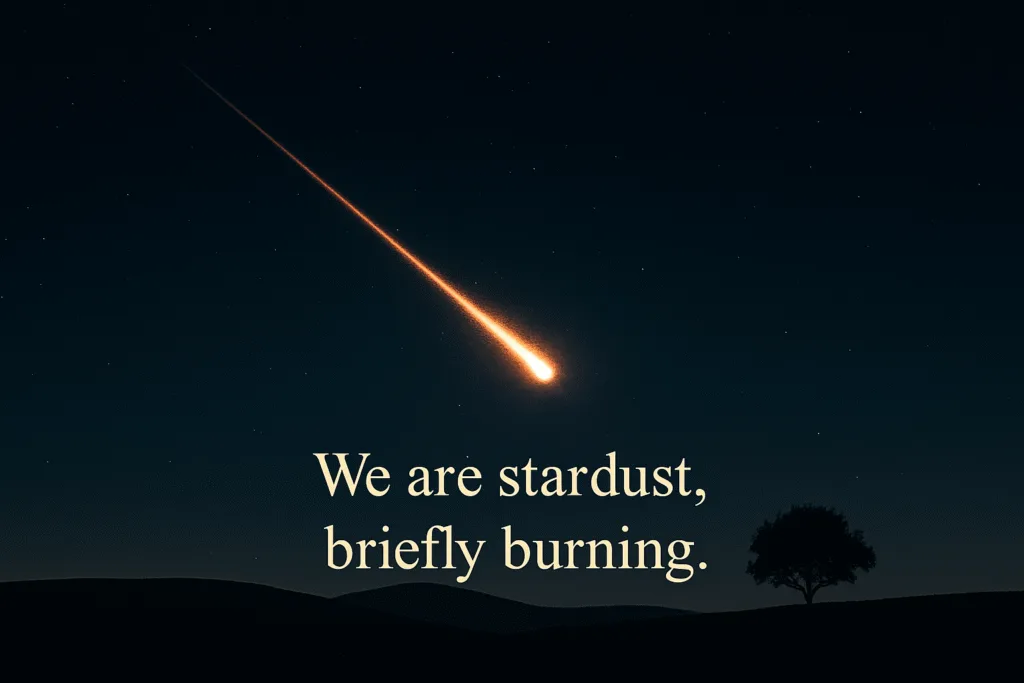
On Sunday evening, just after 7:30pm, the skies over central Victoria erupted in brilliance.
A meteor—large, fiery, and unforgettable—streaked across the horizon, lighting up towns from Bendigo to Ballarat, Melbourne to Fryerstown. Witnesses described it as volcanic in texture, glowing orange and red, with black rock formations visible as it passed overhead. Some saw shimmering tails of blue and silver. Others felt the ground shake.
And then came the boom.
Sue from Woodend said her house “seemed to lift up and drop down again.” Saskia Reus-Smit, watching from Fryerstown, described the meteor as “close enough to see burning definition,” followed by a “massive boom” that shook her home. In Strathfieldsaye, one resident called her neighbour, convinced their house had exploded.
Geoscience Australia received multiple reports from Bendigo, but no seismic activity was recorded. What people felt was not an earthquake—it was a sonic boom. A shockwave from a meteor moving faster than sound.
🔭 A Fireball, Not Space Junk
Experts quickly confirmed the object was a meteor, not debris from a satellite. Amateur astronomer David Finlay, who runs the Australian Meteor Reports Facebook group, said the meteor was likely “anywhere from the size of a grapefruit to a wheelbarrow.” Its brightness and the sonic boom suggest fragments may have survived vaporization and landed somewhere between Bendigo and Ballarat.
Astrophysicist Jonti Horner added that the fireball was brighter than Venus—a rare event in Australia. “To hear the sonic boom from the ground means a big chunk was close,” he said.
🌌 When the Sky Interrupts
There’s something sacred about moments like this. They interrupt us. They bypass our filters and routines. They remind us that we live on a planet—spinning, fragile, and part of a vast cosmic dance.
We chase clarity through meditation apps and morning rituals. But sometimes, clarity arrives unannounced. In a flash of light. In a rumble beneath our feet. In the hush that follows.
This meteor didn’t just light up the sky—it lit up something inside us. A sense of awe. A reminder of impermanence. A call to presence.
🌿 What the Earth Asks of Us
At The Green Sutra, we believe that soulful living begins with noticing. With reverence. With the kind of awareness that turns a falling star into a teacher.
So what did this meteor teach?
- That beauty is fleeting, and that’s what makes it precious.
- That the Earth is not a given—it’s a gift.
- That clarity doesn’t always come from effort, but from openness.
And maybe, just maybe, it asked us to live a little more lightly. To tread with care. To align our habits with the wonder we feel when the sky speaks.
🪨 Fragments and Footprints
Scientists are now combing through footage to triangulate the impact zone. If fragments are found, they’ll be ancient—possibly 4.6 billion years old, like the Maryborough meteorite discovered in 2015. But even if no stone is recovered, the emotional imprint remains.
For those who saw it, the night was unforgettable. For those who didn’t, the story still resonates.
Because sometimes, the most powerful messages come not from words—but from light, silence, and the trembling of the ground beneath our feet.
FAQ
What exactly happened on Sunday night?
A large meteor entered Earth’s atmosphere over central Victoria around 7:30pm. Witnesses across Melbourne, Ballarat, Bendigo, and surrounding areas saw a bright fireball streak across the sky, followed by a loud boom that shook homes and startled residents
Was it a meteor or space junk?
Experts, including astronomers from Monash University and the University of Southern Queensland, confirmed it was a meteor—not space debris. Its speed, brightness, and sonic boom all point to a natural space rock burning up in the atmosphere
Why did it cause a sonic boom?
When a meteor travels faster than the speed of sound, it creates a shockwave—similar to what happens when a jet breaks the sound barrier. That’s what many residents heard and felt: a sonic boom caused by the meteor’s rapid descent
Did it hit the ground?
Scientists believe fragments may have survived and landed somewhere between Bendigo and Ballarat. The meteor was likely between the size of a grapefruit and a wheelbarrow, and researchers are now reviewing footage to triangulate the impact zone
Can I go looking for meteorites?
Yes—but with care and respect. Meteorites are rare and scientifically valuable. If you believe you’ve found one, it’s best to contact local authorities or a museum. The last major meteorite discovery in Victoria was in Maryborough in 2015, and it turned out to be 4.6 billion years old
Was this part of a meteor shower?
No. Although the Perseids meteor shower is active in August, astronomers say this was a sporadic meteor—unrelated to any known shower. It had a unique trajectory and origin
Why did it feel like an earthquake?
The sonic boom and shockwave from the meteor were powerful enough to shake buildings and rattle windows. Geoscience Australia received reports from Bendigo, but no seismic activity was recorded—it was atmospheric, not tectonic



Leave a Comment