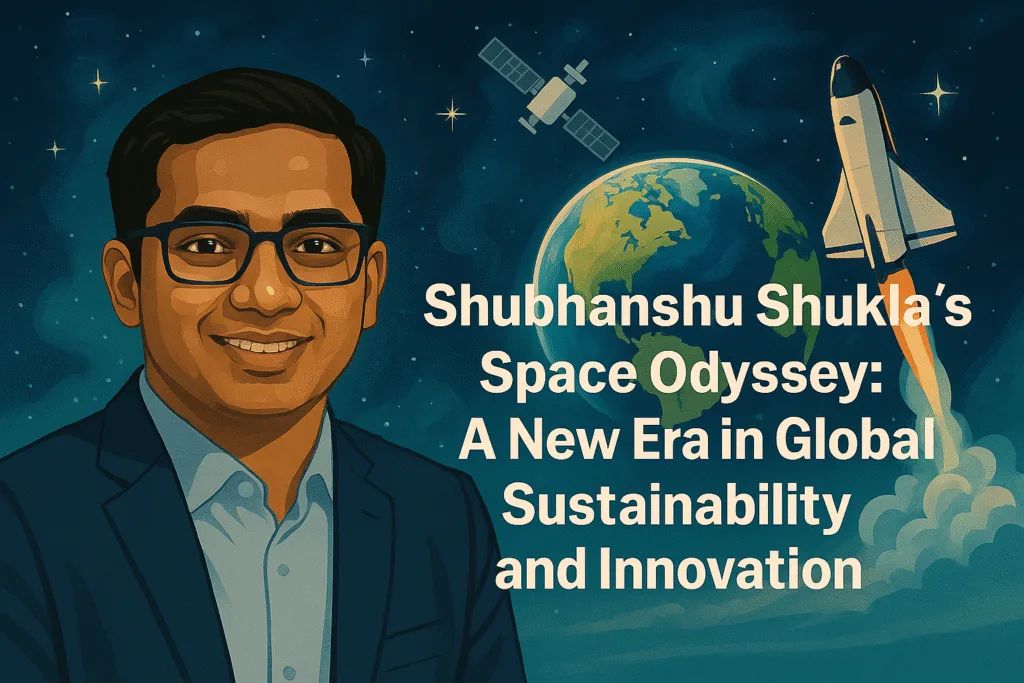
As Group Captain Shubhanshu Shukla returns to Earth aboard the SpaceX Dragon capsule, his journey marks more than a milestone in Indian space history — it’s a powerful symbol of how space exploration is driving global sustainability innovation. The Axiom-4 mission, conducted in collaboration with NASA, ISRO, and international partners, showcases how cutting-edge science, eco-conscious engineering, and cross-border cooperation are shaping a future where space and sustainability go hand in hand.
🌱 Sustainability in Space: Lessons from the ISS
The International Space Station (ISS) is a masterclass in closed-loop living systems — a necessity in orbit, and a blueprint for Earth.
- Water Recycling: The ISS recycles up to 93% of its water, a model for drought-prone regions on Earth.
- Air Revitalization: Advanced CO₂ scrubbing and oxygen generation systems reduce reliance on Earth-based resupply.
- Minimal Waste: Every gram counts in space — packaging, food, and waste are optimized for zero-waste living.
These technologies are now influencing urban sustainability, smart cities, and circular economy models worldwide.
🔬 Shukla’s Experiments: Sustainability in Action
During his 18-day mission, Shukla conducted over 60 experiments that directly support climate resilience, health innovation, and space farming:
| Experiment Focus | Sustainability Impact |
|---|---|
| Microalgae Growth | Produces oxygen, biofuel, and nutrient-rich food for long-duration missions4 |
| Moong & Methi Germination | Tests viability of traditional Indian crops in microgravity — key for space agriculture |
| Bone & Muscle Health | Advances treatments for osteoporosis and muscle degeneration on Earth4 |
| Radiation Exposure Monitoring | Improves astronaut safety and informs Earth-based radiation shielding |
| Stem Cell Research | Explores regenerative medicine in space — potential for cancer and trauma recovery |
These experiments are not just futuristic — they’re immediately relevant to Earth’s challenges in food security, healthcare, and climate adaptation.
🇮🇳 India’s Sustainability Vision in Space
India’s space ambitions are deeply rooted in sustainable development goals (SDGs):
- Mission Akash Ganga: A ₹33,000 crore investment aligning space exploration with eco-conscious innovation.
- Debris-Free Missions by 2030: India pledges to eliminate orbital debris from all missions, setting a global benchmark.
- Gaganyaan & Lunar Goals: Plans to land astronauts on the Moon by 2040 and build a space station by 2035 — with green propulsion and reusable launch vehicles.
India’s approach blends ancient wisdom (like Ayurveda and plant-based living) with modern space tech, creating a unique sustainability narrative.
🌍 Global Sustainability Trends Reflected in Axiom-4
Shukla’s mission intersects with several top ESG and sustainability trends for 2025 and beyond:
International Collaboration: Axiom-4 exemplifies how global partnerships can accelerate sustainability goals.
Planetary Boundaries Framework: Understanding Earth’s limits through space-based data.
Plastic Pollution & Circular Economy: Space missions use biodegradable materials and modular design to reduce waste.
AI & Climate Monitoring: Hyperspectral imaging and autonomous systems tested in space are now used for disaster response and agriculture10.
🧠 Behavioral Sustainability: Mindset Shifts from Space
Astronauts like Shukla embody a lifestyle of intentional living, which can inspire Earth-bound habits:
Community & Ritual: Shukla’s farewell message, “Saare jahan se acha,” reflects a collective ethos that transcends borders.
Mindful Consumption: Every resource is precious in space — a mindset we need on Earth.
Mental Wellness: Space missions prioritize meditation, sleep hygiene, and digital detox — essential for modern burnout culture.
🛰️ SpaceX’s Role in Sustainable Innovation
The Dragon capsule itself is a marvel of eco-engineering:
- Reusable Design: Reduces launch costs and environmental impact.
- Advanced Life Support Systems: Includes air purification, water recycling, and temperature control.
- Fire Suppression & Safety: Uses non-toxic systems to protect crew and environment.
These innovations are now being adapted for terrestrial use — from smart homes to disaster shelters.